A Journey into Financial Planning for Business Owners – Context Financial

Written by   in 

From Printers to People: How One Conversation Changed a Career

In a world where careers often unfold by default, I discovered my calling in financial planning for business owners during a simple lunch with my dad. 

That conversation sparked a career devoted to helping families, entrepreneurs, and business owners navigate money with purpose and clarity.

“I realized I needed to be doing something that had a more positive influence on the world than selling printers.” ~ Josh Ackerman, Certified Financial Planner™


The Spark That Started it All

My path into values-based financial planning began with dissatisfaction. 

I was working in corporate sales and realized I wanted to build something meaningful. My father, who had spent his career in financial services, reminded me that true fulfillment comes from helping others succeed.

By that Friday afternoon, I had closed one last deal and signed up for my first Certified Financial Planner course. What began as curiosity became a lifelong commitment to succession planning and long-term relationships with family-owned businesses.

YouTube Shorts

[Embed 1] [Embed 2] [Embed 3] [Embed 4] [Embed 5]


Why Fit Matters More Than Sales

In financial services, chemistry and trust are everything. I’ve learned that if a client and I don’t connect, the best outcome is to part amicably.

“If you and I don’t connect, the worst thing I could do is convince you to work with me anyway.”

That belief has shaped how I approach every relationship at Context Financial. I focus on transparency, building trust, and ensuring my clients always feel understood.

Discover the Power of Authentic Financial Planning for Business Owners

Because your plan should fit your goals, not the other way around.

[Learn More]

Financial Planning is a Verb, Not a Product

For me, financial planning for entrepreneurs isn’t about selling a one-time plan. It’s about the ongoing planning process.

Building Trust Through Process

True planning evolves as life does. It requires ongoing communication and adaptation, especially during moments of change such as retirement, business succession, or family transitions.


Speaking Financial

I often say, “I speak financial.” My mission is to translate complex financial language into something everyone can understand.

According to the first-ever S&P Global FinLit Survey, only 57% of U.S. adults are financially literate, underscoring the need for this translation.

Two Mindsets: Scarcity and Abundance

I help clients identify their emotional relationship with money. 

By balancing fear and optimism, they learn to create both security and growth. This balance is one of the key ingredients in sustainable succession planning..


Category

Scarcity Mindset

Abundance Mindset

Core Belief

Money is limited; if someone else gains, I lose.

Money is a tool; success expands when shared.

Emotional Driver

Fear, anxiety, and control.

Gratitude, optimism, and curiosity.

Decision Style

Avoids risk and prefers the familiar.

Takes calculated risks and embraces opportunity.

Focus of Attention

Preservation and protection of what already exists.

Creation, growth, and long-term value.

View of Others

Competitors who might take what’s mine.

Collaborators who can help everyone succeed.

Language Patterns

“We can’t afford that.” “What if it runs out?”

“How could we make that work?” “Let’s find a way.”

Business Behavior

Hoards resources, delays investments, resists delegation.

Reinvests strategically, empowers others, and plans proactively.

Impact on Relationships

Leads to tension, secrecy, or guilt about money.

Builds trust, openness, and shared financial goals.

Result Over Time

Stability without progress; missed opportunities.

Sustainable growth, flexibility, and confidence.


Related Blogs to Explore

Taking a Step Back to Move Forward When Retirement is Around the Corner

Smart Strategies for Passing Down the Family Farm

Thinking About Selling Your Business? Start Here

The Human Side of Numbers

I often tell people that financial planning for business owners is “the most liberal arts career ever created.” It blends math, psychology, and communication to help people align money with meaning.

As an educator at the University of Kentucky, I’ve had the privilege of helping shape the next generation of advisors through the Certified Financial Planner program. My teaching philosophy mirrors how I work with clients: relationships first, numbers second.

A recent CFP Board study found that 93% of advisors say their work provides personal fulfillment because it improves clients’ lives; a truth I embody daily.

Moving from Transaction to Transformation

What began as a career pivot from printers to people has grown into a mission to guide family business transitions and personal wealth planning with empathy, clarity, and trust.

Success, for me, isn’t measured in assets. It’s measured in confidence. My goal is simple: to help every client see the full picture of their financial future and prepare emotionally for what’s next.

If you’re a business owner thinking about your next chapter, start early. Begin by discussing your business exit strategy, goals, and life after the transition.

Ready to explore your next step? Contact us today.
Listen to the Podcast on Bitly!

Bonds, Crypto and a Big Boat

Written by   in 

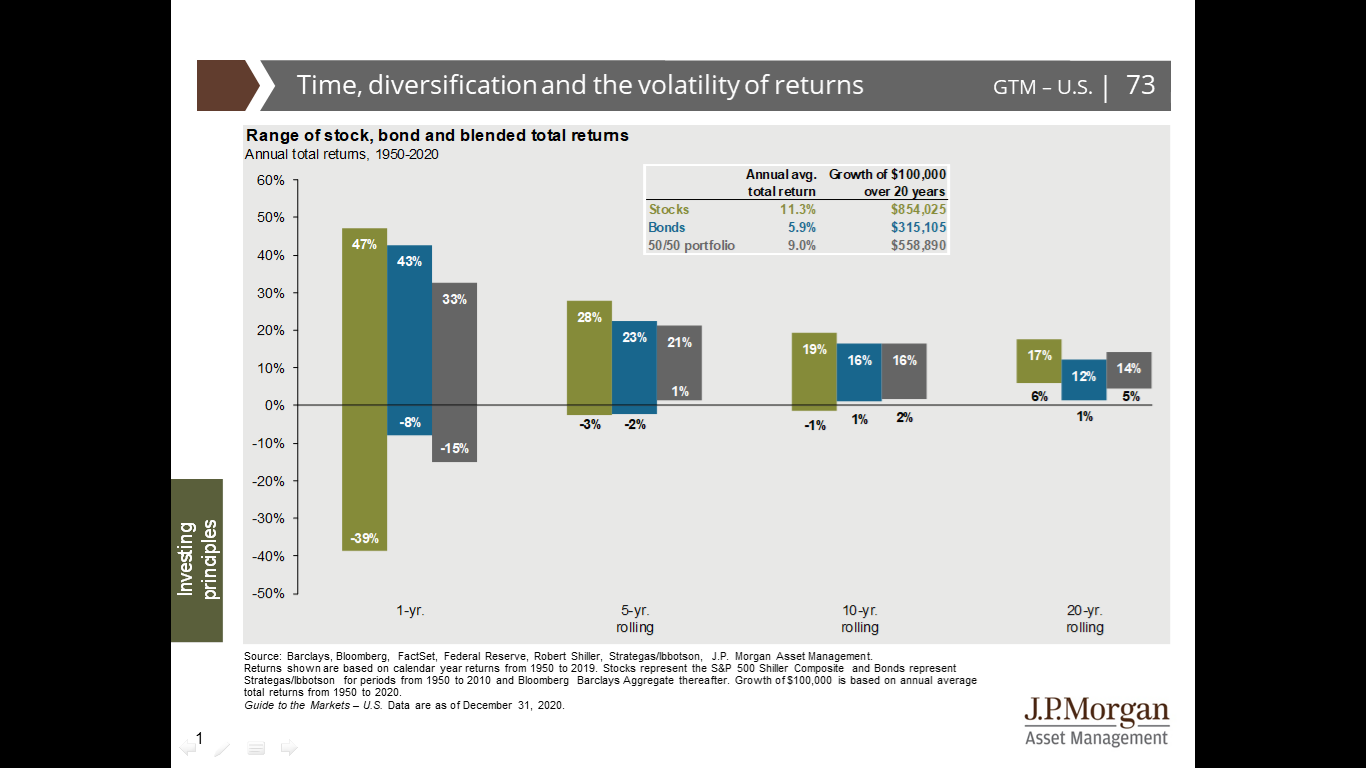
A slightly different format this week. I’ve been reading investment articles, and I thought I’d highlight the parts that interested me. Here is a striking chart from a great article I got from Blackrock. The important lesson here is that very few of our clients actually have the classic 60/40 portfolio. And this chart kind of explains why.  With interest rates down around zero for the next year or two, the yield on bonds isn’t going to be anything to brag about. Our Yield model, which would benefit greatly from 14% yield in Treasury bonds, is heavy in dividend paying stocks.

There is still a place for bonds in the portfolio. They are a useful “insurance policy” when the market gets flustered.

Read More

Watch the Right Market

Written by   in 

This is a blog I’ve wanted to have for a while now. The chart above shows average returns for various asset classes over a period of time. As you can see, the longer the time frame, the smaller the columns get. This means the range of returns narrows.

Here’s where it matters to us. Part of our job is helping clients make decisions about how to invest their money in order to reach their goals. An early conversation about investing will often include a discussion about “the market” and the potential direction of a particular part of that market. This conversation is heavily influenced by the left side of the chart. That’s where the financial press finds stories. If there is volatility in the returns, that means there may be a way to turn that into a story, “Stock A has unexpectedly gone down, or up. Stock B has done the opposite!” That’s where the drama comes from.

Read More

Taking a Step Back to Move Forward When Retirement is Around the Corner

Written by   in 

The Story

Charles and Lisa had been clients for years. We had an exemplary advisor/client relationship: open, clear, and regular communication, and mutual trust. We had long maintained a plan that everyone had confidence in when we suggested taking part in a new exercise.  

As trusted stewards of others’ money, we prioritize regularly participating in professional development opportunities. We had recently completed a refresher on the Financial Life Planning program. Our relationship with Charles and Lisa pre-dated this approach, so although we felt we knew them thoroughly, we knew that going back to basics could only strengthen their financial plan. They agreed.

Read More

Substitution Bias

Written by   in 

Over the past six months, markets have marched higher almost uninterrupted since the lows back in March, just as the economy was thrown into the deepest recession since the Great Depression. Many investors find this disconnect between the equity market and the economy perplexing and are constantly asking us: is it justified?

The media often interchange the economy and the stock market: when the economy is booming we would expect stocks to behave similarly. This seems logical given U.S companies are based, operate and sell in the U.S. and economic growth impacts company revenue and profits. Likewise, when the economy is in a recession or recovering (as it is now) we would expect stock market movements to mirror (or at the very least be highly correlated) to that changing economic conditions. However, simply taking these assumptions at face value reflects substitution bias.

Substitution bias is the very natural and normal tendency to take mental shortcuts in trying to arrive at a complicated answer, which sometimes leaves us without a complete understanding of the problem itself. Luckily, by leveraging data, checking across sources and, most importantly, being open to a more complex discussion can help in getting around this bias.

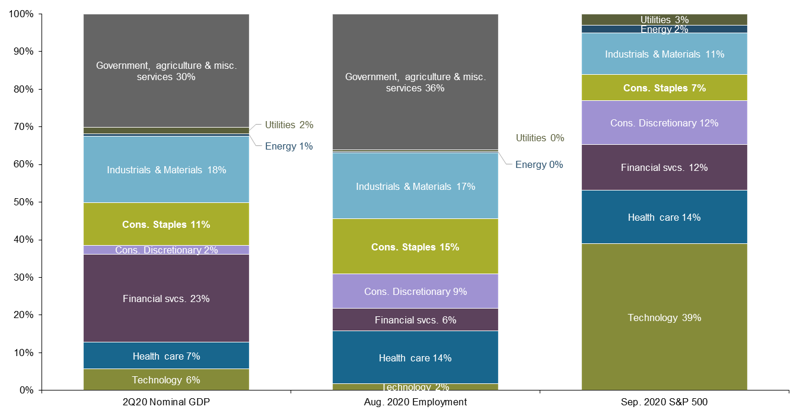
While it is always hard to fully attribute where market gains and losses emanate from, we can point out that the economy and the stock market are not in fact 1 to 1 in the U.S. As shown, the composition of the equity market is heavily weighted to technology at 39%, which has done extremely well during this time, yet only 2% of total payroll jobs (Chart 1). Going deeper into the service sector, the industries most impacted by COVID-19 (including retail, hotels and tourism, transportation, entertainment, and restaurants) represent 20% of all payroll jobs and 19% of GDP, yet these same industries only represent about 7% of S&P 500 earnings.

In summary, while the stock market and the economy are linked, they have drastically different compositions, which can lead to the economy and markets appearing to be on different wavelengths. By yielding to substitution bias, investors may think the market rally is not justified, but a deep look under the surface suggests that in fact, it is.

Sector share of GDP, employment, S&P 500

Retirement and a Gift Box

Written by   in 

The Story
Ginger has always been good at being thrifty. It’s who she is. Though she had significant sources of income and had saved well, it was challenging for her to feel confident that her savings were sufficient to live on for the rest of her life. This is true for a lot of people: it is difficult to interpret the implications on day-to-day life by looking at one lump sum of one’s worth.
Ginger came to us wanting to know that what she had meticulously saved throughout her life would simply be enough.

Read More

What if Retirement Talk Comes too Late?

Written by   in 

The Story
Bill and Mary have both led full, successful careers. Their combined salaries support a high standard of living. They consistently contribute to retirement accounts and have assumed that this is enough to carry their standard of living through retirement. When the couple began discussing retirement, they assessed their accounts. The money seemed like a healthy amount. But for a second opinion, they sought our professional advice. When we translated the sum of savings to a monthly budget, Bill and Mary were stunned. The monthly amount was not nearly what they’d thought it’d be.

Read More

Retirement For a Planner, When the Plan Changes

Written by   in 

The Story
We met Steve when he was in his late 50’s. He had worked as an engineer for all of his life, and he was starting to think about the next chapter. With an excellent pension and an IRA, he knew he was set for a secure retirement – five to seven years in the future. But Steve was ready to
make that future his reality much sooner. We became his partner in figuring out how to help Steve retire on his terms.

Read More

Retirement For a Person Who Loves to Travel – and Will Work to Get There

Written by   in 

The Story
Alicia and her husband, Leon, both found careers in real estate. She’s a broker; he worked with mortgages. But if you met them at a party and were to ask them about themselves, this is not the first thing they would tell you. Instead, they’d likely tell you about their bike tour of The Netherlands last month, and their planned trip to the French Riviera they are currently planning. For them, work has always been a means to an end – not the end itself. This is where our conversations with the couple started.

Read More

Retirement When You Love What You Do, But Want to Slow Down

Written by   in 

The Story
Paul is an attorney. That is who he has always been – it is how he, and those around him, have defined his identity. Throughout his career, he’s put in the long nights and extra miles. Eagerly. He loves what he does; he loves the craft of it. Now approaching the next decade of his life, things are changing. He and his wife, Lucille, began asking: What does retirement for us look like?

Read More